



| Certifico: Informazione tecnica HSE / 25° anno / Documenti disponibili: 43.904 / Totale documenti scaricati: 31.667.443 Vedi Abbonamenti, Prodotti tecnici e Software 2025 * Dati in real-time da Aprile 2014 alla data odierna. |

| Certifico 2000/2024: Informazione Utile / Documenti disponibili: 43.904 * / Totale documenti scaricati: 31.667.443 * Vedi Abbonamenti, Prodotti e Software 2024 * Dati in real-time da Aprile 2014 alla data odierna. |

| Certifico 2000/2024: Informazione Utile / Documenti disponibili: 43.904 * / Totale documenti scaricati: 31.667.443 * Vedi Abbonamenti Promo 2023 * Dati in real-time da Aprile 2014 alla data odierna. |

| Certifico 2000/2023: Informazione Utile / Documenti disponibili: 43.904 * / Totale documenti scaricati: 31.667.443 * Vedi Abbonamenti Promo 2023 * Dati in real-time da Aprile 2014 alla data odierna. |

| Certifico 2000/2023: Informazione Utile |

| Certifico 2000/2023: Informazione Utile |

| Certifico 2000/2023: Informazione Utile Abbonamenti Promo fino al 20 Agosto - 20% ticket "CERTIFICO20" Vedi Abbonamenti Promo: 2X, 3X, 4X, Full | 2023 |

| Certifico 2000/2023: Informazione Utile Abbonamenti Promo fino al 20 Agosto - 20% ticket "CERTIFICO20" Vedi Abbonamenti Promo: 2X, 3X, 4X, Full | 2023 |

| Certifico 2000/2023: Informazione Utile / Documenti disponibili: 43.904 * / Totale documenti scaricati: 31.667.443 * Vedi Abbonamenti Promo 2023 * Dati in real-time da Aprile 2014 alla data odierna. |


| Certifico 2000/2022: Informazione Utile Tutti i Software, Prodotti e Documenti Tecnici presenti sono elaborati direttamente o selezionati su Norme Tecniche & Standards riconosciuti. Vedi Abbonamenti Promo: 2X, 3X, 4X, Full | 2022 |

| Certifico 2000/2021: Informazione Utile Tutti i Software, Prodotti e Documenti Tecnici presenti sono elaborati direttamente o selezionati su Norme Tecniche & Standards riconosciuti. Vedi Abbonamenti Promo: 2X, 3X, 4X, Full | 2021 |
|
|

Documenti
Legislazione
Direttive Sicurezza
Timeline Sicurezza IT
D.Lgs. 81/2008
Interpelli
Soggetti abilitati
ATECO / Livello rischio
Cassazione
Convenzioni ILO
TUSSL / Link


Documenti
Legislazione
Testo Unico Ambiente
Interpelli ambientali
Elenco CER
RENTRi


Documenti
Legislazione
CLP consolidato
REACH Consolidato
Seveso III
PXXX | EUH | HXXX
Elenco gas tossici
Parametri acque

Documenti
Legislazione
Norme armonizzate Click
Direttiva click
Nuovo approccio


Attività PI
D.P.R. 151/2011
Moduli PI
Codice RTO II
Norme PI 2022
Decreti PI Sett. 2021


Documenti
Legislazione
Tremcards
Etichette ADR
Kemler

Regolamento macchine
Direttiva macchine
Documenti Regolamento
Norme armonizzate
CEM4 | Software

HACCP (CE) 852/2004
MOCA (CE) 1935/2004
GMP (CE) 2023/2006
MOCA - GMP consolidato
Food Safety book

Documenti
Legislazione
DM. n. 37/2008
Legge n. 10/1991

Norme armonizzate
Direttiva click
Prassi di riferimento
| ID 6486 | | Visite: 12799 | ADR 2019 | Permalink: https://www.certifico.com/id/6486 |
20.02.2019 - Documento completo in allegato Riservato Abbonati (IT)
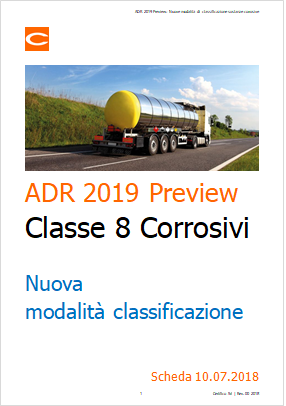
Con l'ADR 2019 è modificata radicalmente la sezione 2.2. Disposizioni particolari per le diverse classi - 2.2.8 Sostanze corrosive
La Classificazione di miscele di sostanze corrosive è allineata a GHS / CLP.
In passato, è stato spesso difficoltoso classificare correttamente le miscele corrosive e trovare i gruppi di imballaggio appropriati. L'ADR 2019 ora permette un approccio graduale, che in gran parte è ispirato al GHS / CLP.
In nero esistente
In azzurro le novità
In rosso il rimando ADR 2019
______
Amend Section 2.2.8 to read as follows:
“2.2.8 CLASS 8 CORROSIVE SUBSTANCES
2.2.8.1 Definition, general provisions and criteria
2.2.8.1.1 Corrosive substances are substances which, by chemical action, will cause irreversible damage to the skin, or, in the case of leakage, will materially damage, or even destroy, other goods or the means of transport. The heading of this class also covers other substances which form a corrosive liquid only in the presence of water, or which produce corrosive vapour or mist in the presence of natural moisture of the air.
2.2.8.1.2 For substances and mixtures that are corrosive to skin, general classification provisions are provided in 2.2.8.1.4. Skin corrosion refers to the production of irreversible damage to the skin, namely, visible necrosis through the epidermis and into the dermis occurring after exposure to a substance or mixture.
2.2.8.1.3 Liquids and solids which may become liquid during carriage, which are judged not to be skin corrosive shall still be considered for their potential to cause corrosion to certain metal surfaces in accordance with the criteria in 2.2.8.1.5.3 (c) (ii).
2.2.8.1.4 General classificationprovisions
[Insert existing 2.2.8.1.2 (Class 8 subdivisions) renumbered as 2.2.8.1.4.1.]
2.2.8.1.4.1.Substances and articles of Class 8 are subdivided as follows:
C1-C11 Corrosive substances without subsidiary risk and articles containing such substances:
C1-C4 Acid substances:
C1 Inorganic, liquid;
C2 Inorganic, solid;
C3 Organic, liquid;
C4 Organic, solid;
C5-C8 Basic substances:
C5 Inorganic, liquid;
C6 Inorganic, solid;
C7 Organic, liquid;
C8 Organic, solid;
C9-C10 Other corrosive substances:
C9 Liquid;
C10 Solid;
C11 Articles;
CF Corrosive substances, flammable:
CF1 Liquid;
CF2 Solid;
CS Corrosive substances, self-heating:
CS1 Liquid;
CS2 Solid;
CW Corrosive substances which, in contact with water, emit flammable gases:
CW1 Liquid;
CW2 Solid;
CO Corrosive substances, oxidizing:
CO1 Liquid;
CO2 Solid;
CT Corrosive substances, toxic and articles containing such substances:
CT1 Liquid;
CT2 Solid;
CT3 Articles;
CFT Corrosive substances, flammable, liquid, toxic;
COT Corrosive substances, oxidizing, toxic.
2.2.8.1.4.2 Substances and mixtures of Class 8 are divided among the three packing groups according to their degree of danger in carriage:
(a) Packing group I: very dangerous substances and mixtures;
(b) Packing group II: substances and mixtures presenting medium danger;
(c) Packing group III: substances and mixtures that present minor danger.
2.2.8.1.4.3 Allocation of substances listed in Table A of Chapter 3.2 to the packing groups in Class 8 has been made on the basis of experience taking into account such additional factors as inhalation risk (see 2.2.8.1.4.5) and reactivity with water (including the formation of dangerous decomposition products).
2.2.8.1.4.4 New substances and mixtures can be assigned to packing groups on the basis of the length of time of contact necessary to produce irreversible damage of intact skin tissue in accordance with the criteria in 2.2.8.1.5. Alternatively, for mixtures, the criteria in 2.2.8.1.6 can be used.
2.2.8.1.4.5 A substance or mixture meeting the criteria of Class 8 having an inhalation toxicity of dusts and mists (LC50) in the range of packing group I, but toxicity through oral ingestion or dermal contact only in the range of packing group III or less, shall be allocated to Class 8 (see 2.2.61.1.7.2).
2.2.8.1.5 Packing group assignment for substances and mixtures
2.2.8.1.5.1 Existing human and animal data including information from single or repeated exposure shall be the first line of evaluation, as they give information directly relevant to effects on the skin.
2.2.8.1.5.2 In assigning the packing group in accordance with 2.2.8.1.4.4, account shall be taken of human experience in instances of accidental exposure. In the absence of human experience the assignment shall be based on data obtained from experiments in accordance with OECD Test Guideline 4041 or 4352. A substance or mixture which is determined not to be corrosive in accordance with OECD Test Guideline 4303 or 4314 may be considered not to be corrosive to skin for the purposes of ADR without further testing.
2.2.8.1.5.3 Packing groups are assigned to corrosive substances in accordance with the following criteria (see table 2.2.8.1.5.3):
(a) Packing group I is assigned to substances that cause irreversible damage of intact skin tissue within an observation period up to 60 minutes starting after the exposure time of three minutes or less;
(b) Packing group II is assigned to substances that cause irreversible damage of intact skin tissue within an observation period up to 14 days starting after the exposure time of more than three minutes but not more than 60 minutes;
(c) Packing group III is assigned to substances that:
(i) Cause irreversible damage of intact skin tissue within an observation period up to 14 days starting after the exposure time of more than 60 minutes but not more than 4 hours; or
(ii) Are judged not to cause irreversible damage of intact skin tissue but which exhibit a corrosion rate on either steel or aluminium surfaces exceeding 6.25 mm a year at a test temperature of 55 °C when tested on both materials. For the purposes of testing steel, type S235JR+CR (1.0037 resp. St 37-2), S275J2G3+CR (1.0144 resp. St 44-3), ISO 3574 or Unified Numbering System (UNS) G10200 or a similar type or SAE 1020, and for testing aluminium, non-clad, types 7075–T6 or AZ5GUT6 shall be used. An acceptable test is prescribed in the Manual of Tests and Criteria, Part III, Section 37.
NOTE:
Where an initial test on either steel or aluminium indicates the substance being tested is corrosive the follow up test on the other metal is not required.
Table 2.2.8.1.5.3: Table summarizing the criteria in 2.2.8.1.5.3
|
Packing Group |
Exposure Time |
Observation Period |
Effect |
|
I |
≤ 3 min |
≤ 60 min |
Irreversible damage of intact skin |
|
II |
> 3 min ≤ 1 h |
≤ 14 d |
Irreversible damage of intact skin |
|
III |
> 1 h ≤ 4 h |
≤ 14 d |
Irreversible damage of intact skin |
|
III |
- |
- |
Corrosion rate on either steel or aluminium surfaces exceeding 6.25 mm a year at a test temperature of 55 ºC when tested on both materials |
2.2.8.1.6 Alternative packing group assignment methods for mixtures: Step-wise approach
2.2.8.1.6.1 General provisions
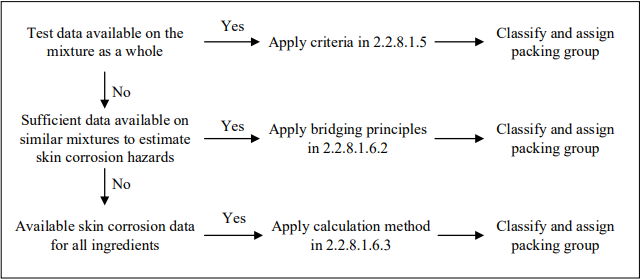
For mixtures it is necessary to obtain or derive information that allows the criteria to be applied to the mixture for the purpose of classification and assignment of packing groups. The approach to classification and assignment of packing groups is tiered, and is dependent upon the amount of information available for the mixture itself, for similar mixtures and/or for its ingredients. The flow chart of Figure 2.2.8.1.6.1 below outlines the process to be followed:
Figure 2.2.8.1.6.1: Step-wise approach to classify and assign packing group of corrosive mixtures
....
segue in allegato
Certifico Srl - IT | Rev. 1.0 2019
©Copia autorizzata Abbonati
Matrice Revisioni
| Rev. | Data | Oggetto | Realizzato |
| Rev. 1.0 | 2019 | ADR 2019 IT | Certifico Srl |
| Rev. 0.0 | 2018 | ADR 2019 EN | Certifico Srl |
Collegati
| Descrizione | Livello | Dimensione | Downloads | |
|---|---|---|---|---|
 |
ADR 2019 Preview - Nuove modalita' di classificazione sostanze corrosive Rev 1.0 2019.pdf Certifico Srl - Rev. 1.0 2019 |
325 kB | 78 | |
|
ADR 2019 Preview - Nuove modalita' di classificazione sostanze corrosive.pdf Certifico Srl - Rev. 0.0 2018 |
532 kB | 49 |
Tags: Merci Pericolose Materia ONU ADR Abbonati Trasporto ADR